Parc de la tannerie (english version)
The « Parc de la Tannerie » along the river Interpretation path
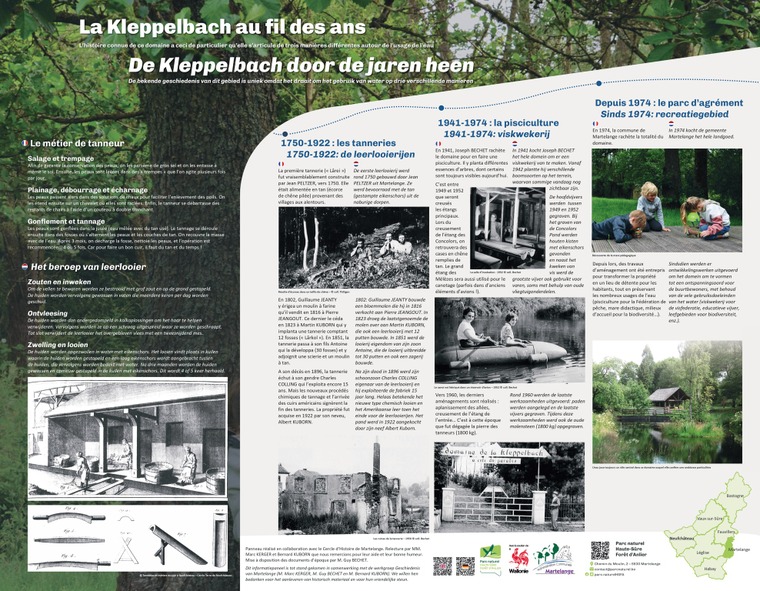
The “Kleppelbach” over the years
The known history of this domain is unique in the fact it is structured in three different ways around the use of water.
The profession of tanner
The salting and soaking
In order to guarantee the preservation of the skins, they are sprinkled with coarse salt and piled up on the ground. Then, the skins are washed in “soaks” which are shaken several times a day.
Plaining, breaking and fleshing
The skins then pass through lime solutions to facilitate the hair removal. They are then spread out on an easel where they are scraped. Finally, the tanner gets rid of the remaining flesh using a double-edged knife.
Swelling and tanning
The skins are swollen in water mixed with used tan (pounded oak bark) . Tanning then takes place in pits where skins and layers of tan alternate. We cover the mass with water. After 3 months, the pit is unloaded, the skins are cleaned, and the process is started again … 4 or 5 times. Because to make good leather you need tan and time!
1750 – 1922 : the tanneries
The first tannery (“Lârei”) was probably built by Jean PELTZER around 1750 and was supplied with tan (pounded oak bark) from the surrounding villages. In 1802, Guillaume JEANTY built a flour mill here, which he sold to Pierre JEANGOUT in 1816. In 1823, the latter sold it to Martin KUBORN, who set up a tannery with 12 pits (“Lârkol”). In 1851, the tannery passed to his son Antoine, who expanded it to 30 pits and added a sawmill and a tanning mill.
When he died in 1896, the tannery passed to his son-in-law Charles COLLING, who ran it for a further 15 years. But new chemical tanning processes and the arrival of American leathers signalled the end of the tanneries. The property was acquired in 1922 by his nephew, Albert KUBORN.
1941-1974 : fish farming
In 1941, Joseph BECHET bought the estate to turn it into a fish farm. He planted various species of trees, some of which can still be seen today.
The main ponds were dug between 1949 and 1952. When the Concolors pond was being dug, oak huts filled with tan were found. The large Mélèzes pond was also used for canoeing (sometimes in old aircraft parts!).
Around 1960, the final improvements were made : levelling the pathways, digging the entrance pond, … It was at this time that the tanner’s stone (1800 kg) was unearthed.
Since 1974 : the leisure park
In 1974, the commune of Martelange bought the entire estate.
Since then, development work has been undertaken to transform the property into a place where local residents can relax, while preserving the many uses to which the water is put (fish farm for the fishing federation, educational pond, habitats for biodiversity, …).
Pannel produced in collaboration with the “Cercle d’Histoire de Martelange”. Proofreading by Marc KERGER and Bernard KUBORN, whom we thank for their assistance and good mood. The original documents were provided by Mr Guy BECHET.
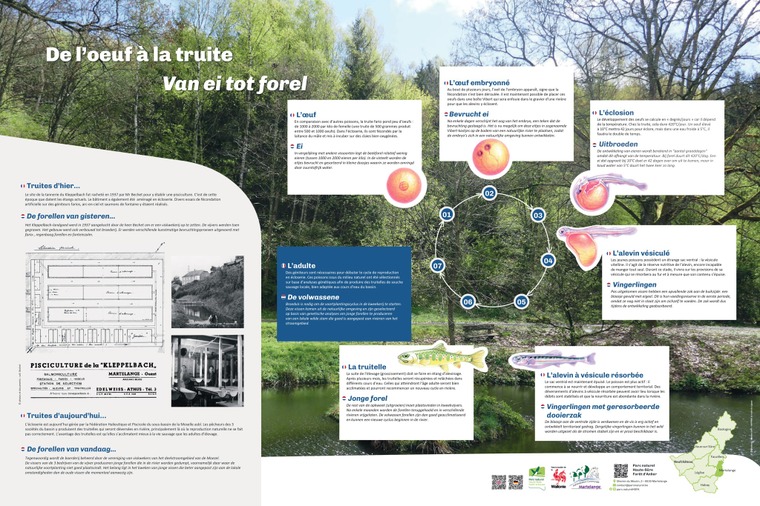
From egg to trout
Yesterday’s trout
The site of the “Kleppelbach” tannery was bought by Mr Bechet in 1937 in order to set up a fish farm. The current ponds date from this period. The building was also converted into a hatchery.
Various artificial fecundation tests were carried out on fario, rainbow and brook salmon broodstock.
Today’s trout
The hatchery is now managed by the Fédération Halieutique et Piscicole du sous-bassin de la Moselle asbl. Fishermen from the 3 companies in the basin produce troutelle that will be
discharged into the river, mainly in areas where natural reproduction does not work properly. The advantage of troutelles that they acclimatize better to life in the wild than farmed adults.
The egg
Compared with other fishes, the fario trout lays few eggs : between 1,000 and 2,000 per kilo of female (a 500-gram trout produces between 500 and 1,000 eggs). In the hatchery, the eggs are fertilized by the male’s milt and incubated on well-oxygenated racks.
The embryonated egg
After several days, the eye of the embryo appears, a sign that fertilization has been successful. These eggs can now be placed in a “Vibert box”, which will be buried in the gravel of a river so that the fry can hatch.
Hatching
Egg development is calculated in “degree/days” because it depends on temperature. By trout, this takes 420° C/day. An egg raised at 10 ° C will take 42 days to hatch, but in cold water at 5° C, it will take twice as long.
The vesiculated fry
Young fish have a strange ventral “sac” : the vitelline vesicle. This is the nutritional reserve of the fry, which is still unable to eat on its own. During this stage, it will live on the provisions of its vesicle, which will be reabsorbed as its contents are depleted.
Fry with resorbed vesicles
The ventral sac is now exhausted. The fish is more active : it starts to feed and develop territorial behaviour. Spillages of resorbed bladder fry can occur when flows have stabilized and food is abundant in the river.
The troutelle
The rest of the rearing (grow-out) should take place in fry rearing ponds. After several months, the troutelle will be recovered and released in different rivers. Those that reach adulthood will be well acclimatized and will be able to start a new cycle in the river.
Adults
Broodstock are needed to start reproduction cycle in the hatchery. These fish come from the natural environment and have been selected on the basis of genetic analyses to produce troutelles of local wild stock, well adapted to the rivers in the basin.
6 easy-to-see amphibians
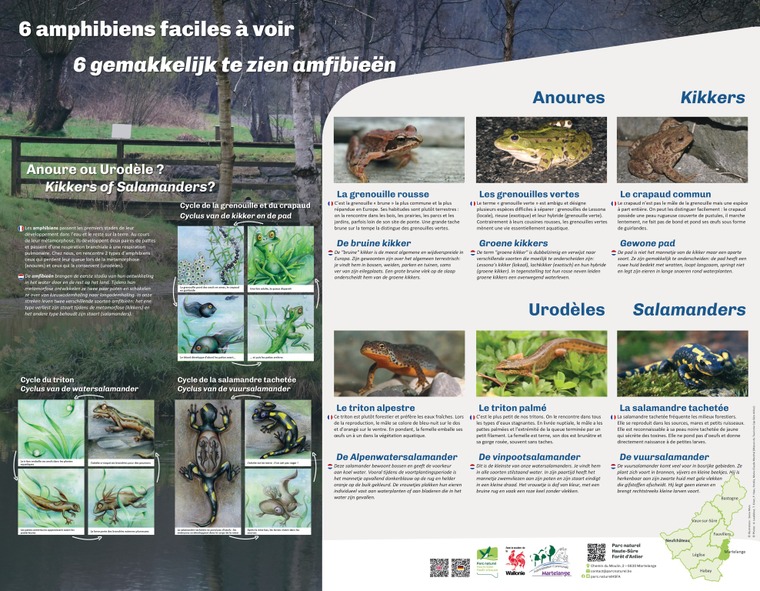
Anurans or Urodele?
Amphibians spend the first stages of their development in water and the rest on land. During their metamorphosis, they develop two pairs of legs and switch from gill-breathing to long-breathing. We encounter 2 types of amphibians : those that lose their tail during metamorphosis ( anurans) and those that keep it (urodeles).
Frog and toad cycle
Fire salamander cycle
Newt cycle
The brown frog
This is the most common and widespread “brown frog” in Europe. Its habits tend to terrestrial : it can be found in woods, meadows, parks and gardens, sometimes far from its egg-laying site. A large brown spot on the temple distinguishes if from green frogs.
Green frogs
The term “green frog” is ambiguous and refers to several species that are difficult to separate : Lessona’s frog (local), laughing frog (exotic) and their hybrid (green frog). Unlike red cousins, green frogs lead a predominantly aquatic life.
The common toad
The toad is not the male of the frog, but a species in its own right. They are easily distinguishable : the toad has rough skin covered in pustules, walks slowly, does not leap and lay its eggs in form of garlands.
The alpine newt
This newt tends to live in forests and prefers cool waters. When breeding, the male is coloured night-blue on his back and orange on his belly.
When laying her legs, the female packs them one by one into the aquatic vegetation …
The palmate newt
This is the smallest of our newts. It can be found in all types of stagnant water. In mating attire, the male has webbed feet and a small filament at the end of his tail. The female is dull, with a brownish back and a pinkish throat, often without spots.
The fire salamander
The fire salamander frequents forest environments. It breeds in springs, pools and small streams. It can be recognized by its black skin spotted with yellow, which secretes toxins. It does not lay eggs and gives birth directly to small larvae.
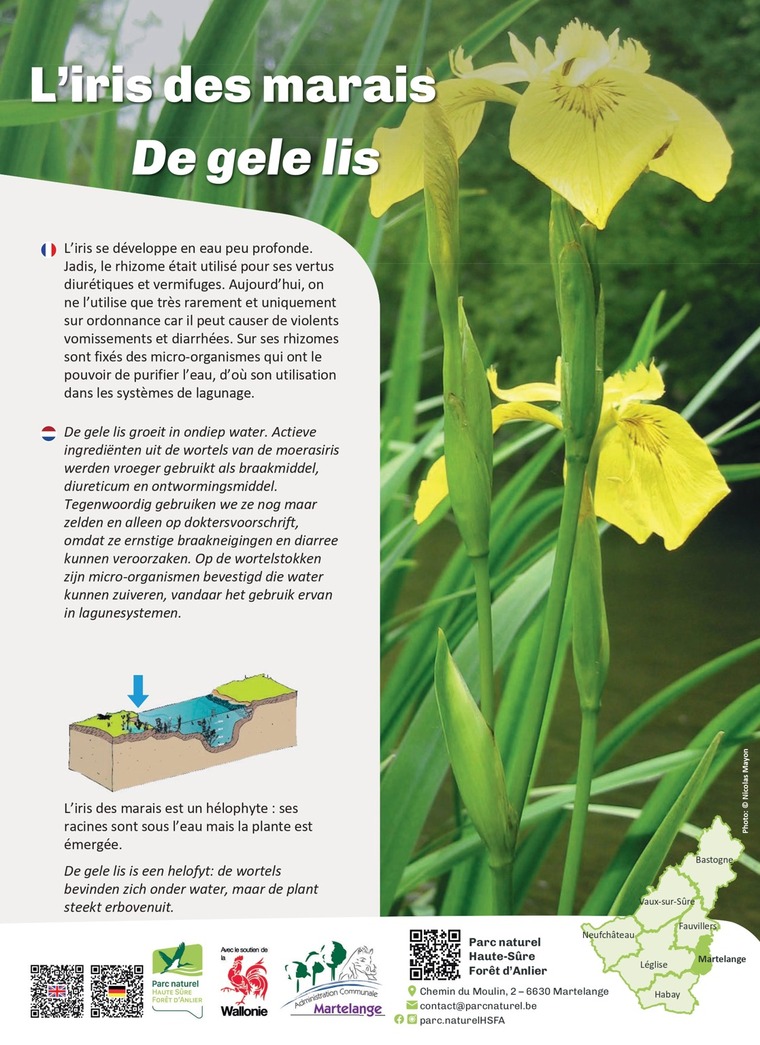
Marsh Iris
The iris thrives in shallow water. In the past, the rhizome was used for its diuretic and vermifuge properties. Today, it is used very rarely and only on prescription, as it can cause violent vomiting and diarrhoea. Its rhizomes contain micro-organisms that have the power to purify water, hence its use in lagooning systems.
The marsh iris is a helophyte : its roots are underwater but the plant is above water
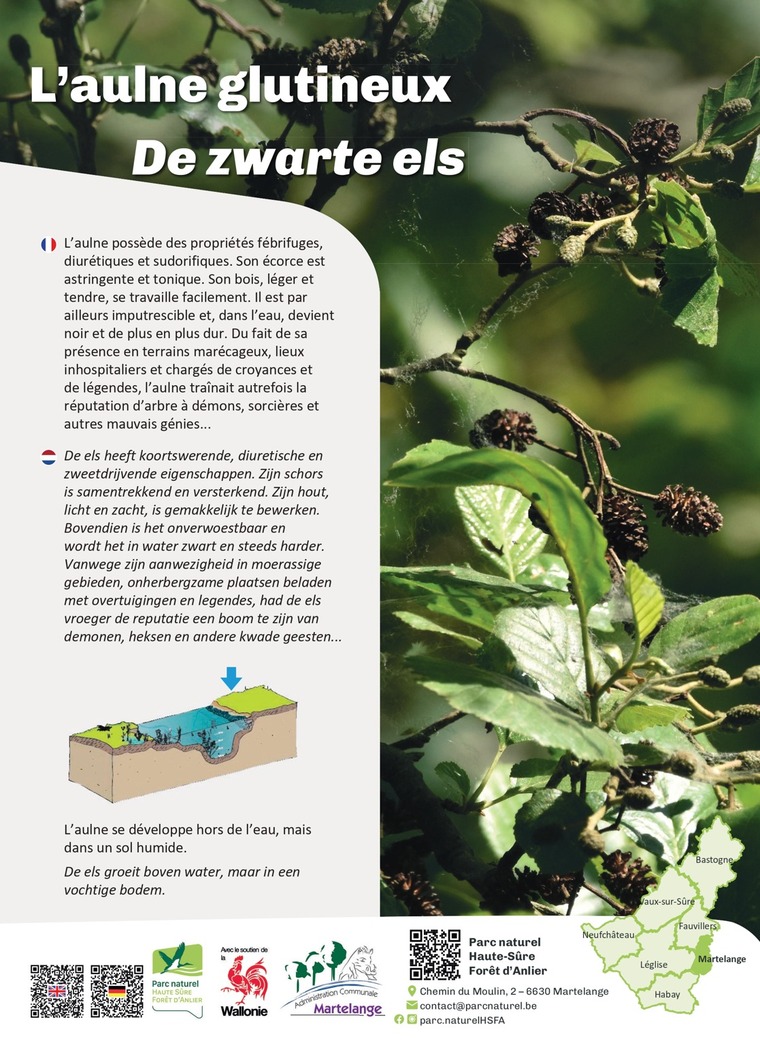
Black alder
Alder has febrifuge, diuretic and sudorific properties. Its bark is astringent and tonic. Its light, soft wood is easy to work with. It is rot-proof and becomes black and increasingly hard in water. Because of its presence in marshy areas, inhospitable places steeped in beliefs and legends, the alder once had the reputation of being the tree of demons, witches and other evil spirits ...
Alder grows out of water, but in moist soil.
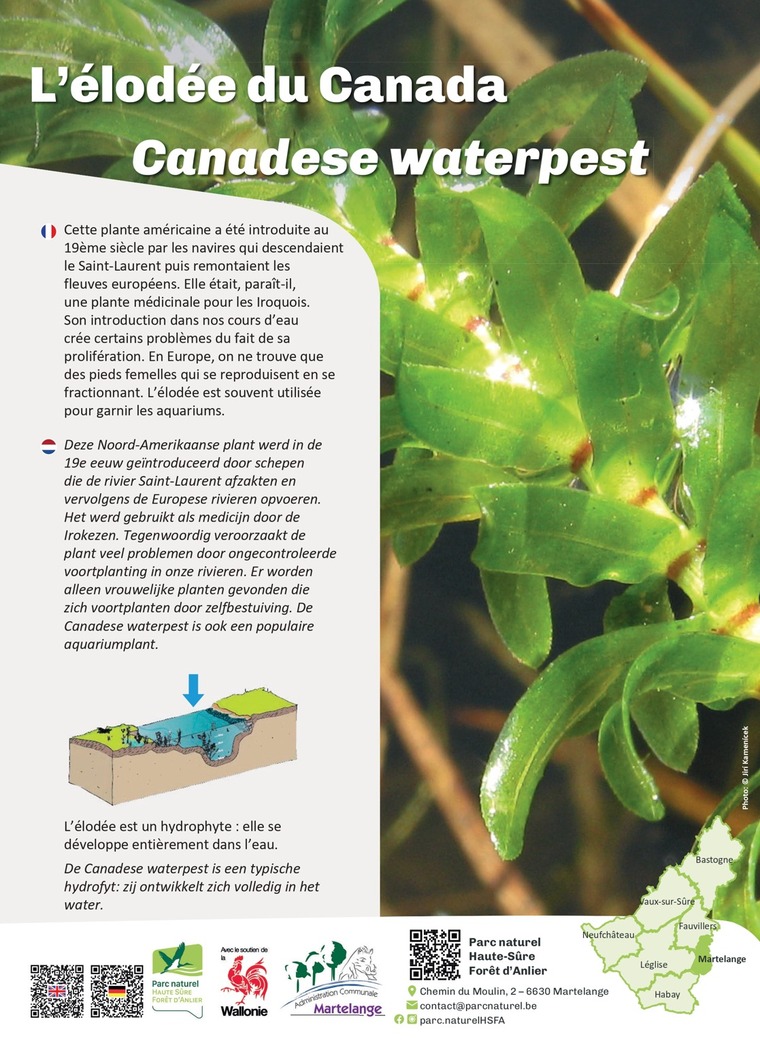
Canadian elodea
This American plant was introduced in the 19th century by ships sailing down the St Lawrence and then up European rivers. It is said to have been a medicinal plant for the Iroquois. Its introduction into our waterways is causing problems because of its proliferation. In Europe, only female plants are found, which reproduce by splitting. Elodea is often used to decorate aquariums.
Elodea is a hydrophyte: it grows entirely in water.
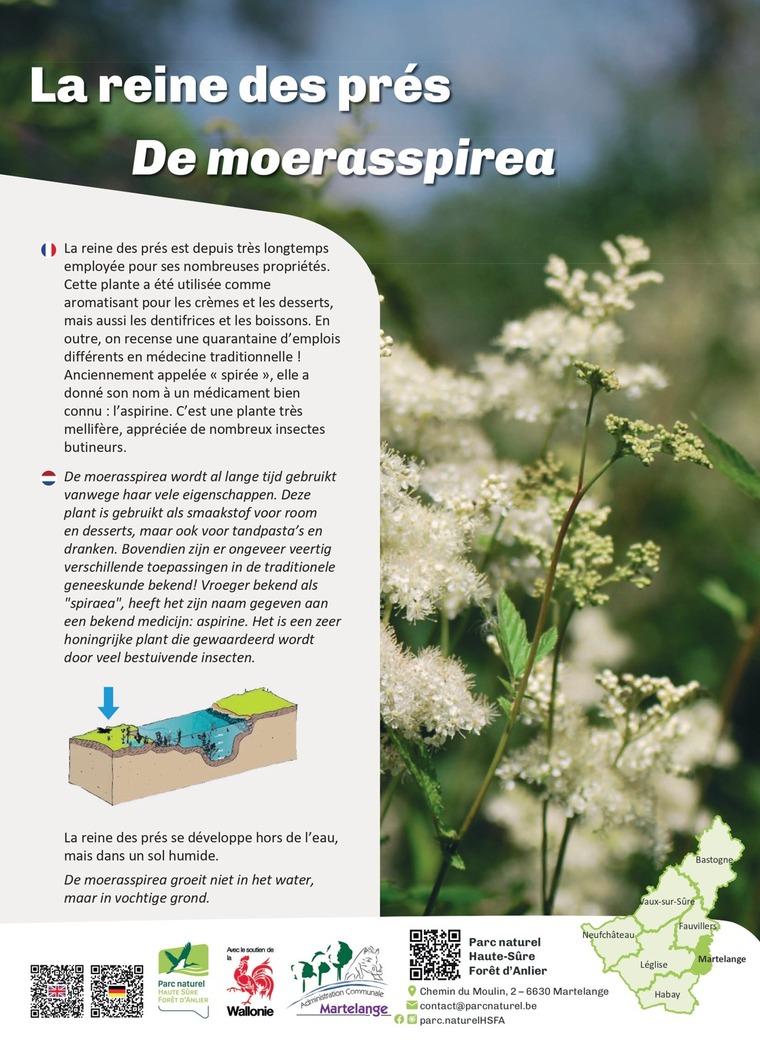
Meadowsweet
Meadowsweet has long been used for its many properties. The plant has been used as a flavouring for creams and desserts, as well as toothpastes and drinks. There are also around forty different uses in traditional medicine! Formerly known as ‘spirea’, it gave its name to a well-known medicine: aspirin. It is a highly honey-producing plant, appreciated by many foraging insects.
Meadowsweet thrives away from water, but in moist soil.
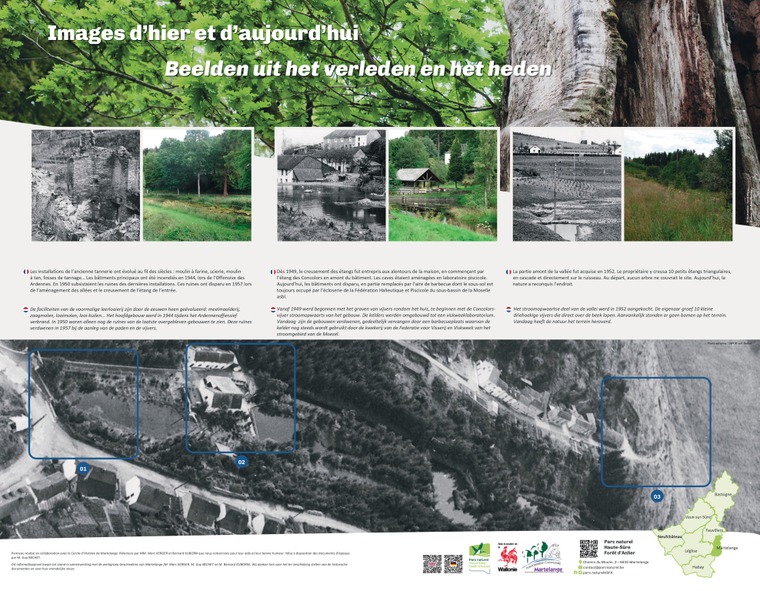
Images of yesterday and today
The facilities at the old tannery have evolved over the centuries: flour mill, sawmill, tanning mill, tanning pits, etc.
The main buildings were burnt down in 1944 during the Ardennes Offensive. In 1950, the ruins of the last installations remained. These ruins disappeared in 1957, when the paths were laid out and the entrance pond dug.
In 1949, ponds were dug around the house, starting with the ‘Concolors’ pond upstream from the building. The cellars were converted into fish-farming laboratories. Today, the buildings have disappeared, partly replaced by the barbecue area, whose basement is still occupied by the hatchery of the Fédération Halieutique et Piscicole du sous-bassin de la Moselle asbl.
The upstream part of the valley was acquired in 1952. The owner dug 10 small triangular ponds, cascading down directly onto the stream. Initially, there were no trees on the site. Today, nature has reclaimed the site.
Panel produced in collaboration with the Cercle d'Histoire de Martelange. Proofreading by Marc KERGER and Bernard KUBORN, whom we thank for their help and good humour. Period documents provided by Mr Guy Bechet.
What was the place like in 1950/51/54?
Remember to slide this shutter to the left as you leave!
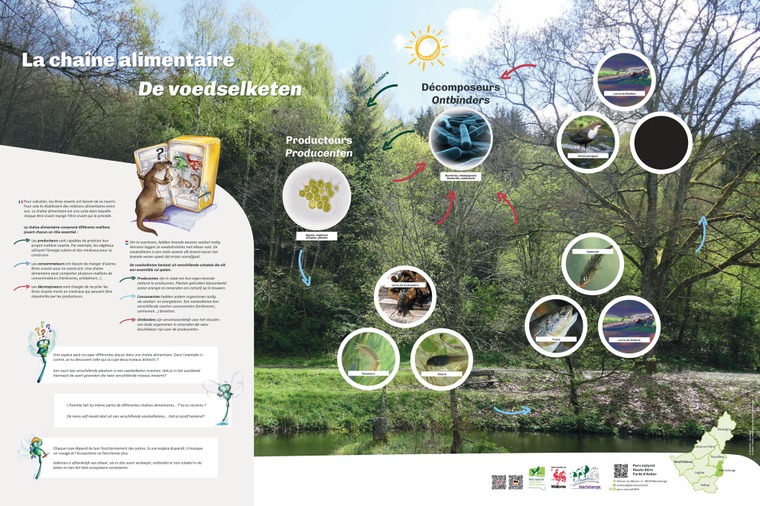
The food chain
To survive, living beings need to feed themselves. To do this, they establish food relationships with each other. The food chain is a sequence in which each living thing eats the living thing before it.
The food chain is made up of different links, each of which plays an essential role:
Producers are capable of producing their own living matter. For example, plants use solar energy and minerals to build themselves.
Consumers need to eat other living things in order to build themselves up. A food chain may have several consumer links (herbivores, predators, etc.).
Decomposers are responsible for recycling dead living things into minerals that can be re-assimilated by producers.
A species can occupy different places in a food chain. In the example opposite, did you find the one that occupies two distinct levels?
Man himself is part of different food chains... Did you recognise yourself?
Each wheel depends on the others working properly. If one species disappears, a cog is missing and the ecosystem no longer functions.
- Producers
- Decomposers
- Algae, plants
- Consumers n°1
- Consumers n°2
- Consumers n°3
- Bacteria and fungi
6 dragonflies that are easy to see
Dragonfly or Damselfly?
Dragonflies are large, robust insects with a powerful flight. At rest, they keep their wings ‘open’, spread out on either side of their body.
In dragonflies and damselflies, colour and pattern generally vary according to sex. By rotating, the plates opposite illustrate either the male or the female.
Damselflies are smaller and thinner. Their flight is also less nervous. When they land, they keep their wings together (or half-jointed) above their body.
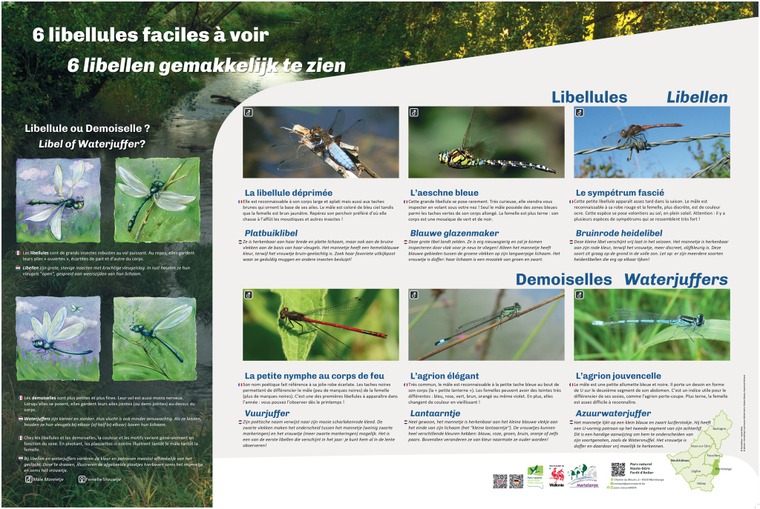
Dragonflies
The depressed dragonfly
This dragonfly can be recognised by its broad, flattened body and the brown spots at the base of its wings. The male is sky-blue while the female is yellowish-brown. Look out for its favourite perch, where it hunts for mosquitoes and other insects!
The blue aeschne
This large dragonfly rarely lands. Very curious, it will inspect you by flying under your nose! Only the male has blue areas among the green spots on its elongated body. The female is duller: her body is a mosaic of green and black.
The Clasped Sympetrum
This small dragonfly appears fairly late in the season. The male can be recognised by its red coat, while the more discreet female is ochre in colour. This species likes to rest on the ground in full sun. Beware: there are several species of Sympetrum that look very much alike!
Demoiselles
The little nymph with the body of fire
Its poetic name refers to its pretty scarlet dress. The black spots can be used to distinguish the male (few black markings) from the female (more black markings). This is one of the first dragonflies to appear in the year: you can spot it as early as spring!
The elegant agrion
Very common, the male can be recognised by the small blue spot at the end of its body (the ‘little lantern’). Females can be very different colours: blue, pink, green, brown, orange or even purple. What's more, they change colour as they get older!
The young agrion
The male is a small blue and black matchstick. It has a U-shaped design on the second segment of its abdomen. This is a useful clue for distinguishing it from its look-alikes, such as the horned agrion. The duller female is quite difficult to recognise.